“Nothing is yours. It is to use. It is to share.”
The Dispossessed“Nothing is yours. It is to use. It is to share.” is a compact statement of Anarresti non-ownership: things may be used, but not claimed as exclusive property, and refusing to share undermines the claim to use them. The maxim begins as a lesson imposed on Shevek in infancy and becomes a principle he carries into adult exchanges with Urras, finally shaping his decision to offer his scientific theory as a gift rather than allow it to become private power or profit.
The Lesson in the Sunlight
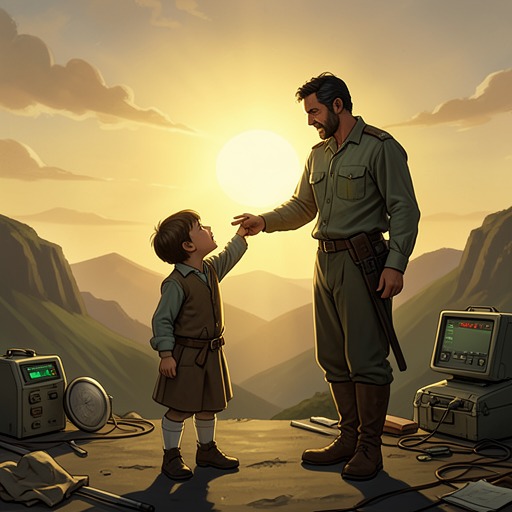
The saying is first enacted in a nursery, where the infant Shevek has occupied a square of sunlight. Another baby sits beside him, crowding him into the shade. Shevek pushes the other child away and cries, “Mine sun!” The one-eyed matron answers, “It is not yours,” and explains that nothing belongs to him: it is for use and sharing, and without sharing he cannot use it. She then lifts him out of the sunny square.
The lesson is concrete rather than abstract. The sunlight is available to both children, but Shevek treats access as a possession he can defend by excluding another. The matron’s response makes sharing a condition of legitimate use, not a charitable addition after ownership has already been established. Shevek shakes and cries in anger; his father picks him up, while the matron observes that some people cannot take life easily. The maxim thus enters the story as a social rule that must be learned against an intense possessive impulse.
From Childhood Rule to Adult Practice
As an adult on Urras, Shevek encounters a society in which necessities and hospitality are organized through buying and payment. When his luggage is lost, he says he has brought nothing and explains the bind: he cannot buy food because he has no money, nor could he have brought enough with him. If his hosts keep him alive, they must give him what he needs. Calling himself the Beggarman, he describes his presence as making Urrasti give rather than sell.
The same ethic informs his response to gifts of clothing arranged for him. Shevek says that he could not bring money because his society does not use it, or gifts because he has nothing they lack; he has come “with empty hands,” like a good Odonian. His hosts assure him that he is a guest and owes no payment, but the exchange remains politically charged: Chifoilisk points out that the Ioti Government is paying the bill. The maxim’s challenge is therefore not simply to refuse objects. It asks what kind of relation an exchange creates—mutual provision, market sale, or dependence on a powerful sponsor.
The Gift of Knowledge
Shevek makes that question explicit in his dispute with Chifoilisk. He says he came to bargain with the profit economy, seeking free exchange between Urras and Anarres and the end of their separation. His purpose is not to keep his discoveries for himself. Later, reflecting on the danger of allowing the propertarians to buy the truth from him, he asks whether there is any alternative to selling and whether a gift is possible.
He then states what such a gift would mean: he wants to give his theory to Keng, Hain, and the countries of Urras, so that no one power can use it to dominate others, grow richer, or win wars. Knowledge, in this account, should circulate for the common good rather than become private profit. Keng replies that truth will usually insist on serving the common good in the end; Shevek refuses to wait for that eventual outcome. He will not spend his one lifetime serving greed, profiteering, and lies, or any master. The nursery lesson has become an adult political choice: sharing is not merely a personal virtue but a way to resist the capture of knowledge by institutions and states.